Las Lomas Passivhaus,
Zaragoza,
Spain
‘Las Lomas Passivhaus’, Spain’s most energy-efficient homes
A pioneering housing project in Spain, renowned for its energy efficiency, is currently under construction in Zaragoza.
Spain’s pioneering energy-efficient housing project is currently under construction in Zaragoza. ‘Las Lomas Passivhaus’ will comprise 13 self-sufficient homes that will incur no electricity or gas bills and will have no environmental impact. Certified by the Passivhaus Institute, these homes will reimburse their owners for any surplus energy they generate.
These detached houses, situated on 1,000 m² plots, offer maximum comfort and a healthy living environment. They will be located in the Las Lomas del Gállego neighbourhood, just 15 minutes from Plaza del Pilar in Zaragoza. The original design by architect Patricia Santos of ARCHI, Atelier Passivhaus, was developed in collaboration with the BIONM studio and executed by ARCHI, Atelier Passivhaus.
Scheduled for completion in spring 2022, ‘Las Lomas Passivhaus’ will be at the forefront of the fight against climate change. It meets the EU directive requiring all buildings to be constructed to Nearly Zero-Energy Building standards with flying colours.
This is the first Passivhaus Premium development in Spain, the most stringent standard in the world in terms of energy efficiency
It takes just a few details to grasp the significance of this Passivhaus certification. It reduces energy consumption by up to 90% and eliminates greenhouse gas emissions from heating and cooling. It generates its own clean energy via solar panels, and any surplus can be used by others without causing pollution. The materials used do not emit gases harmful to health or the environment. But this is just the tip of the iceberg.
As Patricia Santos, an architect at ARCHI, Atelier Passivhaus, points out, “for this development, we have chosen to work with the best brands on the market specialising in Passivhaus. Companies that are committed to more sustainable development and are in line with our way of working”.
“Passivhaus construction offers clients the highest level of comfort and health with the lowest energy consumption. It is the direction the entire sector should be heading in,” says Patricia Santos.
Virtually zero power consumption (standby mode)
Pablo Carranza is the lead architect at BIONM studio and one of Spain’s leading experts in Passivhaus construction, particularly in large-scale projects. As he explains, a building constructed to this standard is “a nearly zero-energy passive-type building, meaning that minimal energy input is still required. Therefore, in the active design of the building, we must focus on the efficiency of its heating and cooling systems so that the energy we supply is used as efficiently as possible”.
“The great advantage of the active design of a Passivhaus is that, once energy demand has been drastically reduced, we can simplify its systems”
In this regard, Carranza points out, “this helps offset construction costs and greatly simplifies the maintenance of the property. For example, by combining the production of heating, cooling and domestic hot water into a single system, such as an air-to-water heat pump. It also combines perfectly with underfloor heating/cooling systems,” says the expert. “The added advantage of this installation proposal is that we can significantly reduce the installed thermal capacity, as it is common to use the smallest units on the market, which are around 3 kW,” he continues.
Minimal ecological and energy footprint
This is what ‘passive houses’ or ‘self-sufficient houses’ are like: buildings with minimal energy consumption and self-generated power. They do not require gas, diesel or any other form of polluting fuel, nor do they emit CO2.
The reduction in emissions at “Las Lomas Passivhaus” prevents the generation of 37 tonnes of CO2 per home per year. This is equivalent to planting 77 trees. In other words, 1,001 trees per year across all the homes, or 10,010 trees over 10 years
It is no coincidence that the Passivhaus Premium standard requires designs to be based on the premise that all energy comes from renewable sources. In short, these homes are far more efficient and consume less energy than those with an A rating.
The keys to comfort and sustainability
How can a home not only save energy, but also generate it? Through whole-house comfort and energy-efficiency systems and the international Passivhaus Premium standards.
Every detail matters. That is why each of the 13 homes in ‘Las Lomas Passivhaus’ has 34 solar panels installed on its roof. Invisible from the outside, they generate five times more energy than they consume.
A key aspect is the even distribution of temperature throughout all rooms. This is where Uponor’s solutions play a vital role. The homes are fitted with the Invisible Climate Control system using Uponor Klett Self-Fixing underfloor heating. It provides thermal and acoustic insulation, requires a shorter response time and does not promote air movement. Manufactured using UAX Technology, this system has a service life of over 50 years.
The Uponor Klett Self-Fixing Invisible Air Conditioning system enhances comfort inside the home and improves air quality.
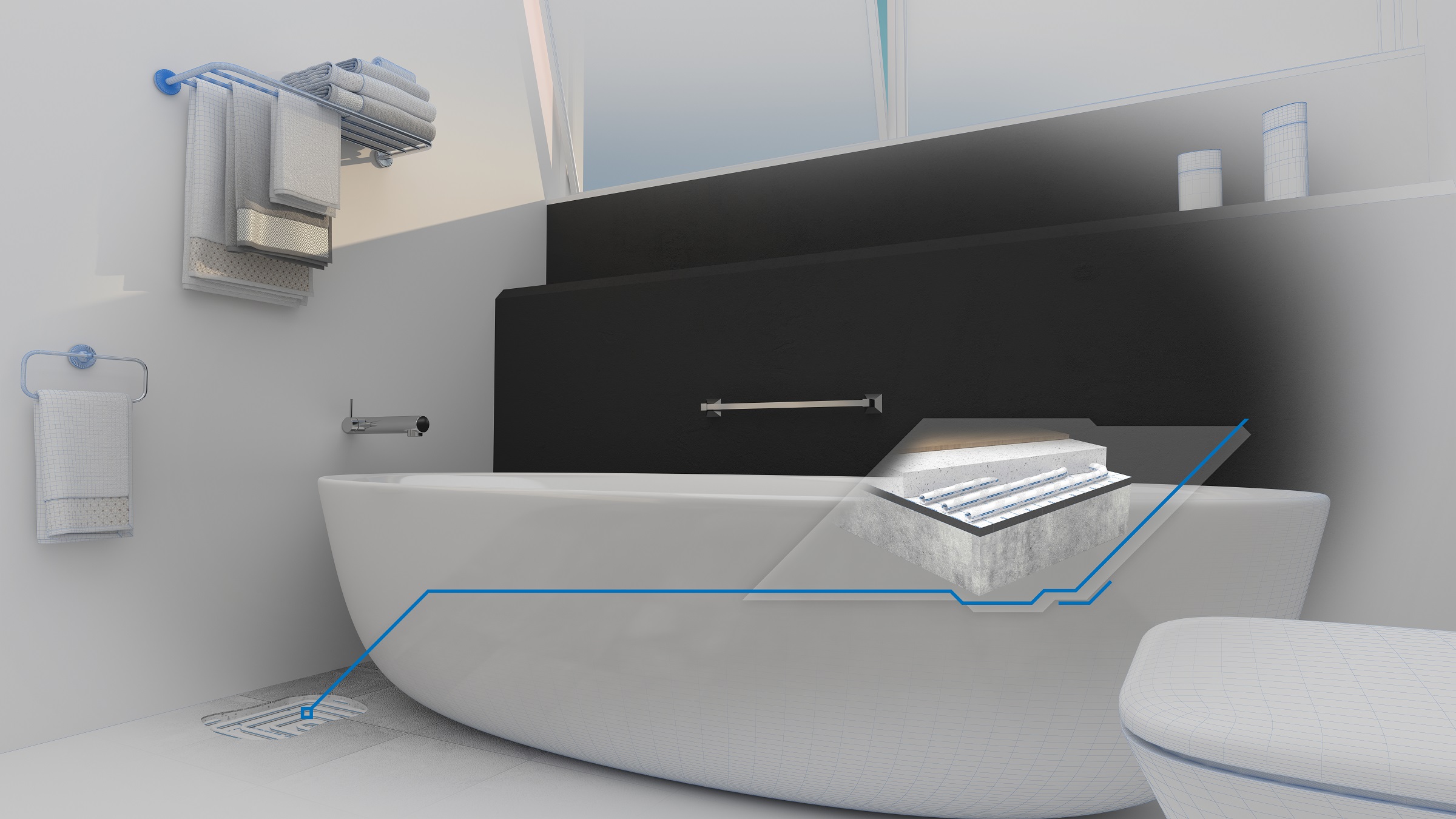
In this regard, the lead architect at BIONM studio points out that Uponor’s solutions “play a key role in ensuring that the energy we supply during both the cold and warm seasons is delivered as efficiently and comfortably as possible. They allow us to provide both winter and summer comfort solutions in a single terminal unit operating at very low temperatures which, in combination with the high-efficiency air-source heat pump, meets the requirement to provide heating and cooling with the greatest possible efficiency,” adds Carranza.
“The design of the Invisible Underfloor Heating solution for a Passivhaus is determined by the heating season. It is the most suitable solution in terms of efficiency, comfort and system simplicity,” says the expert on this certification
Another added benefit, notes Pablo Carranza, is that a Passivhaus home is characterised by “having a mechanical ventilation system with heat recovery that constantly renews the air, operating at very low flow rates and speeds. This has a decisive influence on the end user’s perception of comfort. This requirement must be verified by means of a ventilation balancing test. Uponor’s Invisible Air Conditioning solution using underfloor heating, which generates no draughts, combines perfectly with this system and allows us to maintain the level of comfort of a Passivhaus achieved through improvements to the building envelope and the high standards of its installation design”.
Attention to every detail
The homes also feature insulation in the floors, walls and roofs to ensure a high level of thermal and acoustic comfort. This also prevents any unwanted draughts. The external joinery offers high thermal and acoustic performance to ensure a perfect window seal. It prevents overheating during the warmer months thanks to automated shading control via a motorised blind system. This is activated automatically in response to solar radiation.
A controlled dual-flow ventilation system purifies the outside air and feeds it into the home in a clean state. It also recovers heat or coolness from the stale indoor air before expelling it outside, and moderates the temperature of the outside air as it enters the home. This reduces energy consumption.
Furthermore, the system for generating hot and cold water for domestic use, heating and cooling is based on aerothermal technology. This innovative, energy-efficient system is designed to maintain ideal temperatures even in extreme conditions. In addition, it is powered by electricity, consolidating the property’s energy supply into a single, fixed-rate tariff.
Smart homes
The homes at “Las Lomas Passivhaus” are a prime example of a ‘smart home’, where technology helps to optimise energy use. The home automation system allows you to control the heating and cooling, lighting, ventilation, shading, security, surplus solar power and the electric car charger.
The Uponor Smatrix Pulse Invisible Climate Control system reduces energy consumption by up to 20%. Easy to use, it allows you to maintain a comfortable temperature with minimal energy consumption all year round.
It features an app that allows you to monitor your home’s climate control performance and make adjustments from anywhere. It also lets you set your desired temperature using the Amazon Alexa or Google Home voice assistants.
This control unit, specifically designed for radiant heating systems, was recently awarded the prize for best design of the year by AUNA Distribución.
“Las Lomas Passivhaus” allows residents to use some of their surplus solar power to charge their electric cars at no cost. To this end, each home is equipped with a charging point capable of serving two cars. This forms part of the development’s firm commitment to the environment.
Official certification
The project has been certified by the world’s leading specialist, the Passivhaus Institute. This certification covers the project and the completed building, as well as each of its phases. It confirms that the home meets the highest standards to ensure maximum energy efficiency and comfort.
This certificate has three levels of performance and energy efficiency, from lowest to highest, all of which exceed Class A: Passivhaus Classic, Passivhaus Plus and Passivhaus Premium. “Las Lomas Passivhaus” falls into this last category.
It also provides access to “green mortgages” with excellent financing terms that are only available for energy-efficient buildings. The interest rate is lower than usual, and the more energy-efficient the building, the lower the rate.
Cost-effective
Passivhaus homes cost on average 5% more, but as Patricia Santos points out, this also means “zero euros on electricity and zero euros on gas, forever”. Thirty-four solar panels on each home generate enough energy to cover the home’s entire consumption, whilst also producing a surplus.
“These homes generate five times more energy than they consume. In total, this would amount to a saving of €6,000 per year per home”
Furthermore, Santos explains that, as the homes are certified by a body independent of the construction company, “this ensures strict compliance with the Passivhaus standard throughout the construction process. A range of essential tests and assessments are carried out in order to obtain this certificate, which provides added value for the customer by increasing the value of their home, as it guarantees minimal energy consumption”.
The lead architect at BIONM notes that “the trend in Spain since 2010 has seen a significant reduction. Cost overruns have fallen from around 10% to the current 3%.” This reduction is due to market developments in systems and components, which have created greater competition alongside increased demand, as well as the ongoing training of technicians and professionals in the sector. “The cost differential, if we compare precisely in line with the requirements of the new CTE, has fallen significantly, making the Passivhaus standard even more attractive in terms of energy efficiency requirements,” says this expert.
However, this difference pays for itself within a few years. “The estimated savings on heating and cooling costs will depend on what we’re comparing it to,” says Pablo Carranza. “If we compare with a building constructed before 2006, these savings can reach up to 90%, given that we are talking about buildings where regulations regarding energy performance were minimal. With the entry into force of the technical building code for constructions post-2006 and post-2013, the savings can reach up to 75% and 50% respectively.”
However, this expert points out, “we can provide estimates of energy consumption where the associated cost for heating and cooling is around €1 per square metre per year. In other words, a 200-square-metre home could have an associated cost of €200 per year. The great advantage of the standard is that the results of the energy design can be fully verified during the operational phase, which guarantees our consumption estimates for a maximum demand of 15 kWh/m² per year”, he concludes.
It is also well known that this type of construction helps to prevent faults and problems at handover and thereafter. This is due to the checks carried out before and during each of the various stage-by-stage certifications. They use BIM (Building Information Modelling) software to consult when carrying out renovations or changes to the layout. Put simply, it means you can hammer in a nail without the risk of hitting a pipe or a cable.
A promotion that has been very well received
In February, ‘Las Lomas Passivhaus’ confirmed the project’s popularity, with over 75% of the development already sold. According to Patricia Santos, the typical buyer is “a family committed to protecting the environment, looking for a home that combines comfort and well-being with minimal energy consumption and a minimal environmental impact. We make it possible to live in a more sustainable way”.
Las Lomas Passivhaus
“Passivhaus construction offers clients the highest level of comfort and health with the lowest energy consumption. It is the direction the entire sector should be heading in,” says Patricia Santos.